Desalination3

Direct and intensive desalination
Part1
Desalination3 is a Tocnology3 innovative desalination without treatment, membranes, or heat (direct desalination DD), which represents a significant solution to the Water Desalination Challenge-solved (WDCs). It will overcome the barriers of desalination related to production volume, cost, energy consumption, In addition to environmental issues. The solution methodology relies on an important phenomenon called the 10.3m water level phenomenon (which indicates that no pump can passively lift water above a height of 10.3m). However, Tocnology3 goes further and utilizes this phenomenon to desalinate and treat water in three direct steps, as follows:
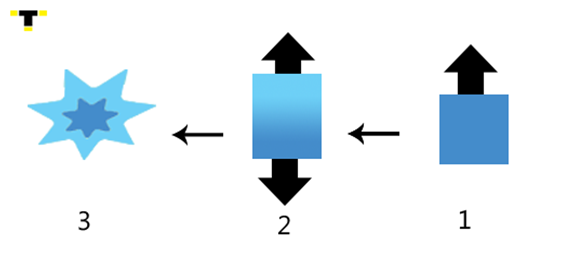
1- Lifting
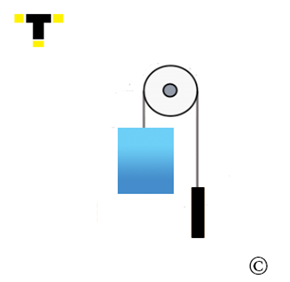
It relies on raising a mass of water above the level of 10.3 m where evaporation and desalination take place, and the system can employ an innovative parallel lifting mass similar to that of elevators to achieve high feasibility and efficiency.
2- Production:
The suspended water mass is subjected to disintegration under the influence of two opposing forces, one upward (lifting force) and the other downward (gravity force and/or a mechanical force that can be achieved by downward pumping) that contribute to disintegration.
3- Harvest:
The process, which is described as not simple, involves collecting water vapor, by condensing it in a process called (Flash Evaporation and Condensation - FEC) into liquid fresh water.
The system:
The innovative desalination3 system, which can be developed with simple modular architectures and varying scales, consists of the following:
1- Structure:
Continuity and viability are achieved through the tripartite structure:
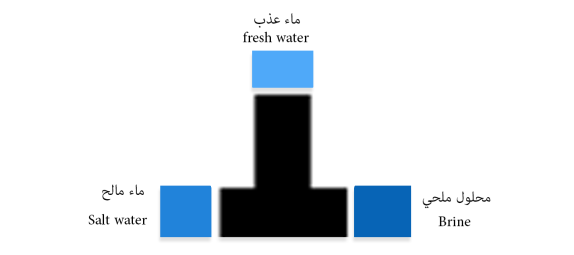
Which can be achieved according to the target capacity through pipe or basin structures as follows:
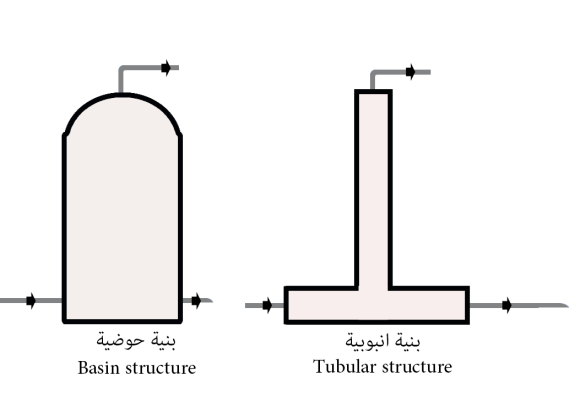
The concepts of vertical or horizontal structure can also be achieved, through which compact systems can be built.
2- Technology:
Tocnology3, through its innovative pumps (Vacuums -Compressors) that achieve Tocnology3 standards and the concept of high centrifugal force and the principles of free motion and flow, plays a key role in the technologies operating the desalination system, as it operates within two levels of the drainage system:
-Lower: For feeding and circulation.
-Upper (central): This consists of innovative pumps called Al-Mosraat or Water Desalination Centrifuges® (WDCs), capable of performing desalination tasks in the system with exceptional efficiency.
3- Flow:
The system achieves a continuous flow due to its structure and operating technologies, and includes:
- Down flow: To circulate water and treat the (optional) brine resulting from desalination, concentrate and store it for other uses or mine it (with the possibility of disposing of it deep or far away)، this process can achieve zero/no waste brine and the system can be calibrated to achieve zero/no brine®.
- Up flow: This is where fresh water is produced and harvested.
The Parameters (flow allowance):
The system has four parameters or levels that define its operation, summarized by the word "CLPH" as follows:
1- Capacity (C): This represents the volume of the desalination system. It should be the highest value.
2- Level (L): This is determined either by sea level or the volume of the water column of the pump at a height of 10.3 meters. It should be the lowest value.
3- Production (P): This is determined by the torque of the pumping system.
4- Harvest (H): This is determined by the speed of the pumping system.
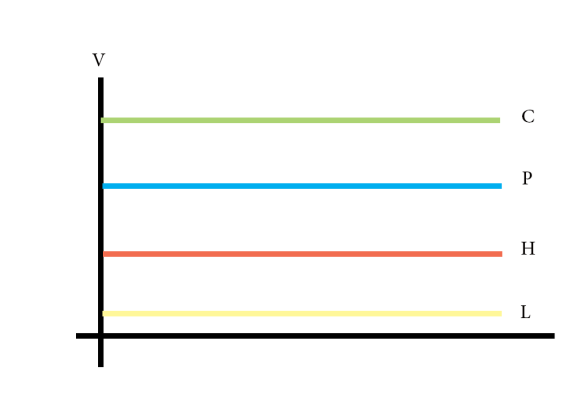
Capacity (C) and level (L) are called the external parameters, while production (P) and harvest (H) are called the internal parameters.
The levels must be maintained in the correct order for a successful and continuous desalination process. The system's efficiency are calculated based on these parameters.
Calcs:
1- Harvesting is calculated from the pumping system speed S using the equation:
Qh = V * S
or
Qh = (π R² h) * Srpm
2- Production is calculated from the pumping system torque T using the equation:
Qp = V * T
or
Qp = (π R² h) * Tnm
An important factor to consider in our calculations is the area A, or contact surface, which represents the surface area between the liquid and gaseous states. This factor affects production and harvesting processes.
Example:
Calculation of the production (required) torque, and feasibility of a desalination unit (pump) with a diameter of 3 meters, a height of 1 meter, and a speed of 10,000 rpm, with an average consumption of 100 KWh.
solution:
Gaseous harvesting rate = 70,650 m³/min.
Liquid harvesting rate = 70,650 / 1700 = 41.5 m³/min.
Harvesting weight = 41,500 kg.
Actual weight = 41,500 / 60 = 691.6 kg.
The production (required) torque = 691.6 * 9.8 = 6778 N·m
To calculate the feasibility:
Daily unit production = 60,480 cubic meters.
Average unit consumption = 100 kWh.
Price per kWh = 1.5 Saudi Riyals.
Daily unit consumption = 2,400 kWh = 3,600 Saudi Riyals.
Cost per cubic meter of water = 0.04 kWh = 0.06 Saudi Riyals.
Scale up:
One of the most important features of the system is its ability of scalability, either by increasing the number of modules, increasing the size, or increasing the speed, as it increases (according to the innovative system architecture) the production torque and size. For example, if we decide to double the speed of the module as in the previous example from 10000rpm to 20000rpm, the torque of the module will double to 13,556 N·m (according to the principle of free motion® of the Tocnology3), and the daily production of the module will also double to 120,960 cubic meters.
Power:
Desalination technologies achieve high energy efficiency, making all types of energy sources—conventional, renewable, and even newable®—strong options for powering them. These include: 1- Highly efficient conventional energy sources; 2- Marine energy, such as wave energy with varying intensity and direction, which can be harnessed to generate significant vibrational energy (mechanical resonance) within the system, contributing to faster and more efficient production and harvesting processes. The innovative WEVER-3® system, which efficiently harvests 3 marine energies (waves, wind, and solar); 3- The desalination system can also be integrated into a power generation system, such as DEEP3 (water, power, and mining) plants; 4- A fully self-powered system can be created using new energy sources by integrating critical systems like the innovative Grounders® ground-based (hydro) compressor pumping system, which can achieve consistently high volume and pressure flow.
Applications:
With desalination3 (as intensive desalination systems capable of providing enormous quantities of purified water from saltwater or from any other water sources), Direct water needs such as human consumption can be met, or expanded to meet other agricultural or industrial needs, etc. Through desalination3 plants or desalination paths (DePa®), It also contributes to the success of important development projects such as Sorbits. Furthermore, it can fulfill indirect needs and realize the concept of Artificial River Charging® (ARC), which contributes to the design of specialized water cycles by creating new waterways (rivers), revitalizing old ones, or supporting existing ones. It can also renew (recharging) surface and groundwater reservoirs (Or even exploiting it in processes such as Natural- Strategic® treatment, mineralizing and storage of desalinated water), to achieve water abundance or even to meet the needs of coming generations.
Problems and solutions:
• Size: While some may view the size of technologies pumps3 as a drawback, it is actually a technological challenge and achievement. Furthermore, downsizing is possible with increased speed.
• Materials: The operating conditions of desalination3 technologies are demanding in terms of their performance (high speed and torque) and the aggressive (salinity) environments they operate in. All these factors can lead to problems such as pump cavitation. Therefore, the selection of high-performance materials should be a fundamental solution in their construction.
• Obstacles: Air retention in some parts may affect the system's effectiveness. This is addressed through innovative air expulsion valves called Air valves®.
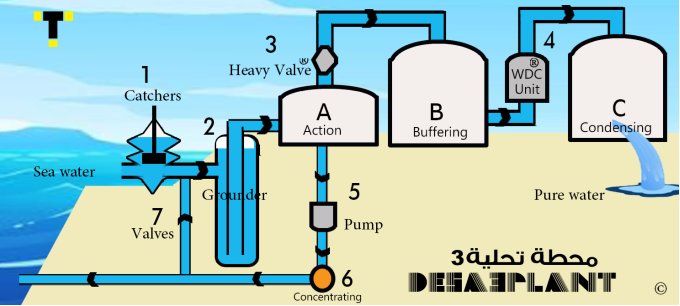
• Shocks: The operating conditions of desalination3 technologies under extremely low pressures can lead to the possibility of sudden and dangerous shocks resulting from a sudden pressure increase (possibly caused by a sudden fracture)، known as water hammer Or what we call here a water projectile. This can be mitigated by incorporating safety technologies such as heavy valves®, shock-absorbing tanks, and others. And as in the following desalination3 plant model (which we will discuss in detail in Part 2):
Importance:
• A mechanism for direct desalination without restrictions.
• It represents a new, innovative, and different generation of water desalination technologies.
• It expands the uses of desalination beyond current human needs to include other industrial and agricultural applications, etc.
• It expands the scope of treatment to include other polluting sources such as grey or even black.
• It enables desalination to be achieved through plants or paths of desalination ®DePa.
•It achieves important concepts such as treating, mineralizing, and Natural-strategic® storage.
• A source of fresh water similar in its properties to naturally distilled rainwater.
• It contributes to achieving water sustainability for future generations.
• It enhances water security and protects natural resources.
• It supports the transition to an advanced, knowledge-based, and technology-driven water industry.
• It can achieve the concept of large-scale desalination, or what we call Mega-Desa®.
• It helps address the challenges of water scarcity and climate change.
• It contributes to restoring global water balance.